People:
I am a great believer in “Get the people right and the rest will follow”. Define clear ownership with defined roles, and decision-making structures that match the complexity of the programme.
An ERP implementation is not a “side project.” It is a business transformation that requires the right people, in the right roles, with the authority to act.
Why Team Structure Matters
ERP systems are highly configurable, but they are not self-directing. Without clear accountability:
- Decisions stall or are revisited repeatedly
- Business requirements conflict across departments
- Vendors fill the leadership vacuum—often unintentionally
- Timelines slip while costs continue to rise
A strong ERP project team provides governance, direction, and speed. A weak one introduces risk before any configuration is completed.
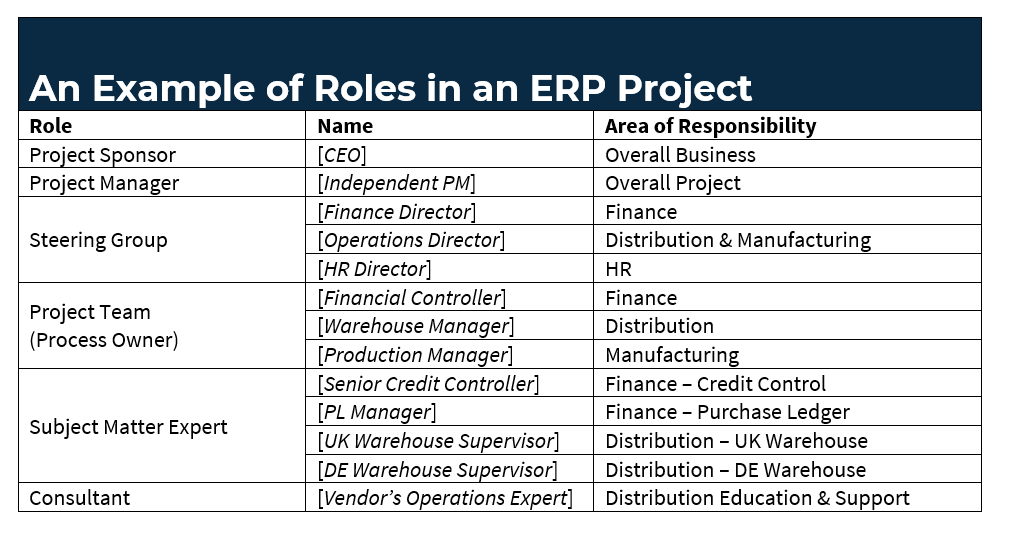
Core Roles Every ERP Project Needs
While every organisation is different, successful ERP programmes consistently include the following roles.
Sponsor
The sponsor owns the outcome of the project at a business level.
Key responsibilities:
- Sets strategic direction and success criteria
- Resolves escalated issues and cross-functional conflicts
- Secures funding and organisational commitment
This role cannot be delegated to someone without authority. A disengaged or symbolic sponsor is a material risk.
Business Process Owners
Process owners represent end-to-end business functions such as Finance, Order-to-Cash, or Procure-to-Pay.
Key responsibilities:
- Define and approve future-state processes
- Make decisions when trade-offs are required
- Play a key role in ensuring testing is complete and appropriate
- Own adoption and outcomes after go-live
Without empowered process owners, ERP projects can end up with unrealistic solutions that satisfy no one.
ERP Project Manager
The project manager is the integrator of people, plans, and decisions.
Key responsibilities:
- Owns the integrated project plan and delivery cadence
- Manages risks, dependencies, and change control
- Enforces governance and decision-making discipline
This role must be independent, experienced, and focused on delivery—not pulled into solution design or day-to-day operations.
Subject Matter Experts (SMEs)
SMEs provide detailed operational knowledge and validate that the system supports real-world scenarios.
Key responsibilities:
- Provide detailed requirements and validation
- Participate in design reviews and testing
- Act as change champions within the business
A common mistake is underestimating the time SMEs need to be effective, leading to rushed decisions and rework later.
Systems Integrator and Vendor Teams
Implementation partners bring technical expertise, but they should not own business decisions.
Key responsibilities:
- Configure and build the solution as directed
- Advise on best practices and constraints
- Deliver against agreed scope and milestones
Clear boundaries are essential. Vendors should inform decisions, not make them.
Common Team-Related Failure Patterns
In troubled ERP projects, you will typically see:
- Too many people with influence, but no clear decision owner
- Critical roles assigned “part-time” with no backfill
- Governance bodies that meet but do not decide
- Expecting vendors to define business processes
These are not technical problems. They are leadership and structure problems.
What Strong ERP Leaders Do Differently
Effective ERP project leaders:
- Ensure roles and responsibilities are defined from the outset
- Motivate and support the project team
- Clearly communicate progress
- Escalate quickly and decisively
They understand that clarity throughout the programme is essential.
Final Thought
ERP success is built on accountability. When roles are clear, decisions accelerate, risks surface earlier, and the organisation moves together rather than in conflict.
If you are planning an ERP implementation and want an objective assessment of your project structure, an experienced ERP project manager can save you a lot of misspent time and effort.